Tag Archives: review

1994 AMC Theater Box/Hallmark Klingon Bird of Prey Giveaway

This 1994 AMC theater and Hallmark promotion was something I had never heard of before. Lynn Norton shared images of a box that appeared in 1994 theater lobbies and the artwork is absolutely gorgeous. I have never seen an example of this piece and have no idea how many theaters it ended up in or how widely the promotion ran. A truly rare piece.
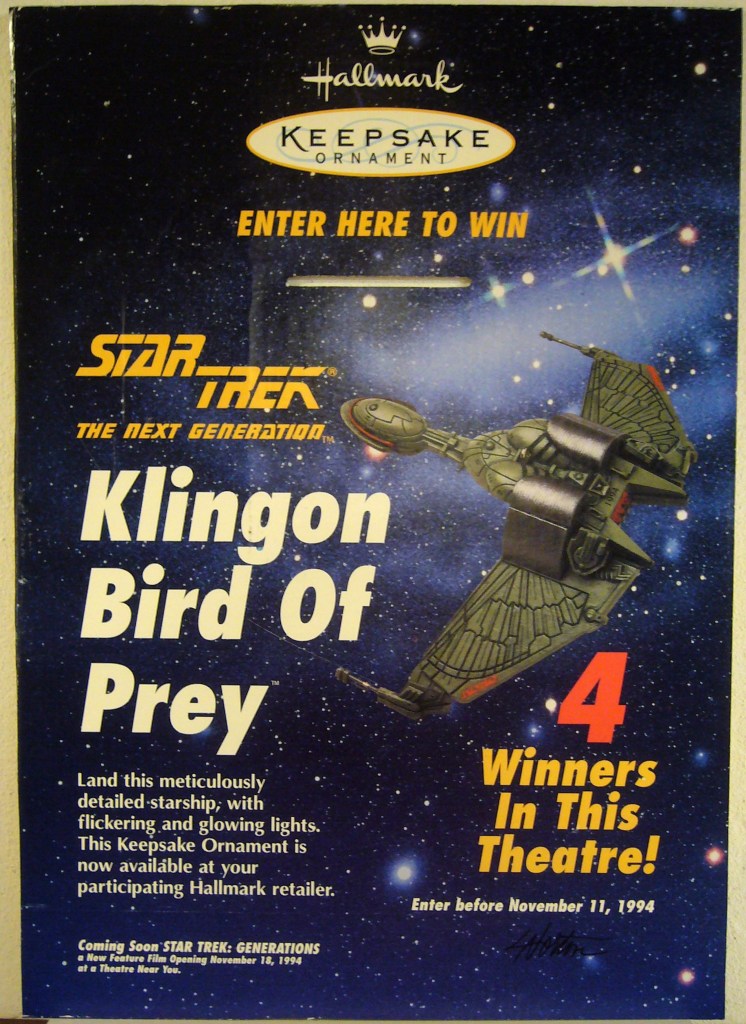
Approx. 20” x 28”

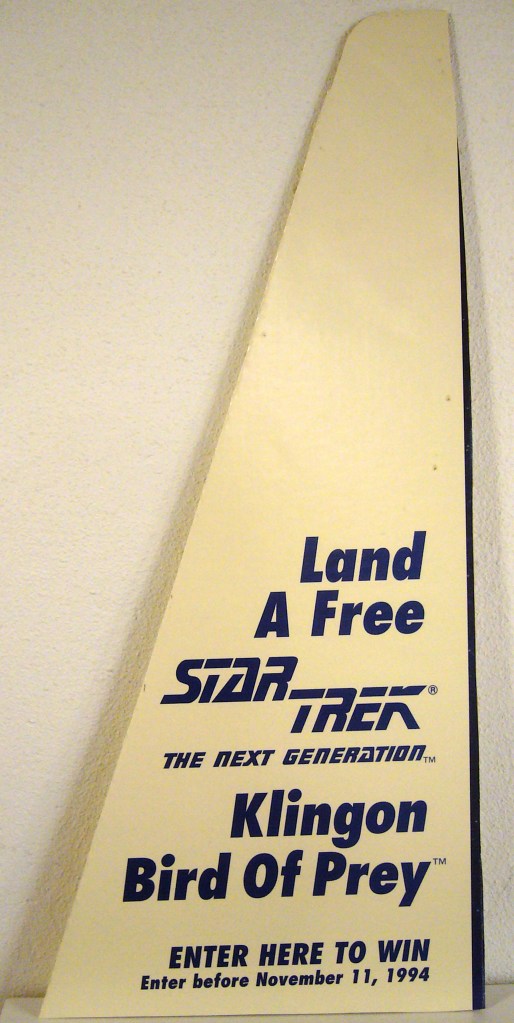
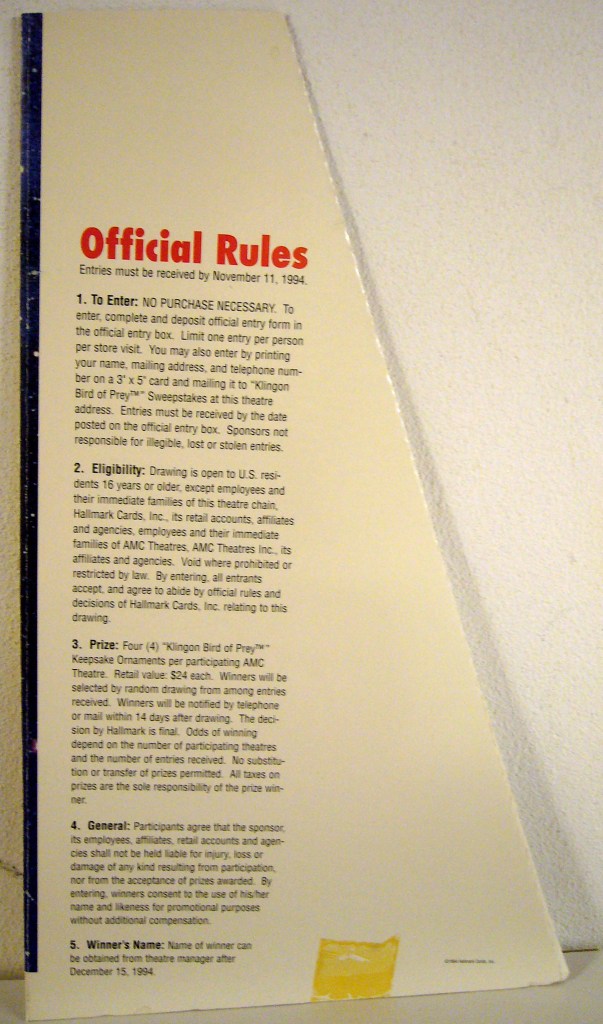
Lynn Norton: This was the face of a wedge-shaped corrugated box used to collect entry forms in theater lobbies. It has a slot cut into it under “ENTER HERE TO WIN” a 1994 KBOP Hallmark ornament. The original box was damaged by a leaking roof in our old studio. The back panel and base were discarded due to severe damage. The original container was folded/tabbed white corrugate with instructions printed on the back (see below).
I don’t have any examples of entry forms but suspect they may have been similar to forms used in Hallmark retail stores. The large photograph of a KBOP ornament is of my hand-painted original prototype (as were all images printed on retail boxes, catalogs and promotional materials). The collection-box photograph reveals paint chipping on both disruptor-cannon barrels. I fabricated the barrels with formed/soldered brass wire and painted them with water-based paint, which wasn’t durable enough for repeated handling.
My original concept drawing of the KBOP ornament was rejected. Hallmark creative-directors were uncomfortable enough with an “alien, bad-guy” STAR TREK ornament but obvious, exposed weapons was too much to ask. Also, quality-control managers warned of consumer, stabbing injuries. I had to remove the cannons from concept drawings in order to get approval. The licensor and I continued to pester Hallmark management with the notion that STAR TREK is a fantasy and weapons are part of storytelling. By the time I was putting finishing touches on the original sculpture, disruptor-cannons were approved for the ornament. It was decided to manufacture the barrels with soft, flexible plastic to avoid damage and injury. The soft plastic originally performed well, but gets brittle with age and becomes more prone to breakage. Win some. Lose some.

Artist Inspirations: Star Trek: Strategic Operations Simulator Arcade Game (2025)

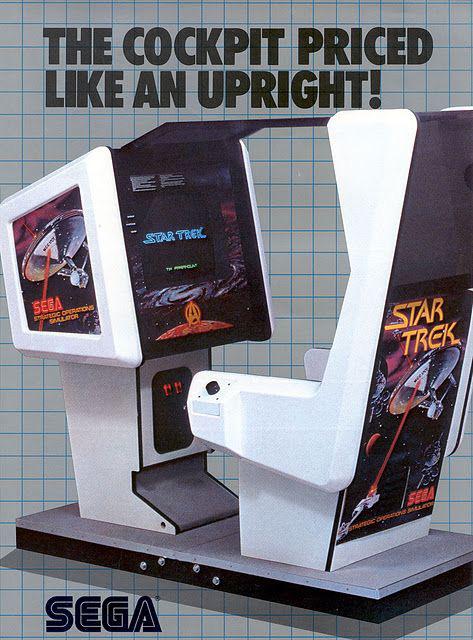
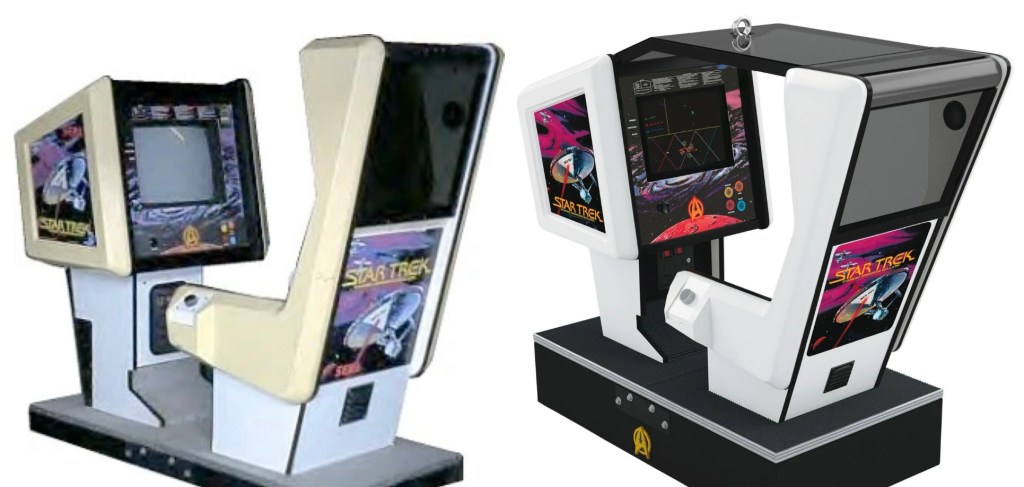
“I still am pinching myself that it actually exists. Keepsake Artist Orville Wilson and Hallmark sound engineer Chris Johnson did masterful work bringing this to life considering the lengths we went for source material. The sculpt is based on dozens of photos I took of a sit-down cabinet on display in the Pinball Hall of Fame in Las Vegas, Nevada. The cabinet graphics were recreated by Orville from art on a brochure for the game I picked up on eBay. The gameplay heard in the ornament and seen on the display was captured while I played an online emulator of the game.” -Kevin Dilmore
Screen graphic of the Kobayashi Maru from Star Trek II: The Wrath of Khan.

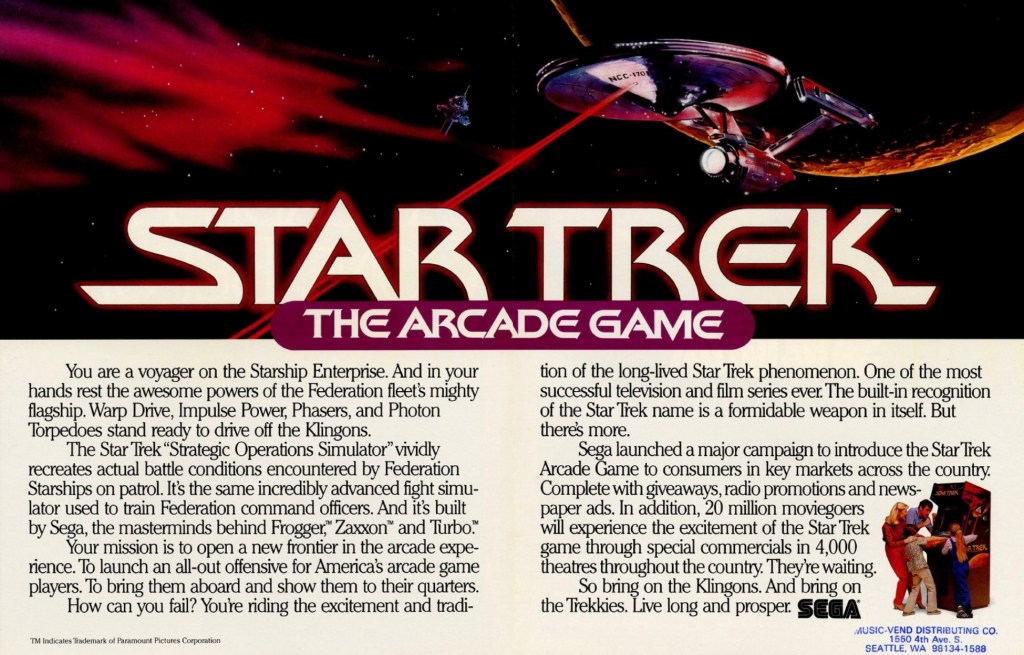
The Star Trek: Strategic Operations Simulator arcade game by Sega was the first official Star Trek arcade video game. Released in January 1983, it was inspired in part by the Kobayashi Maru simulation seen in Star Trek II: The Wrath of Khan. Its vector graphics display was meant to mirror those seen in the beginning of the film. Leonard Nimoy and James Doohan provided the voices of their Star Trek: The Original Series characters.

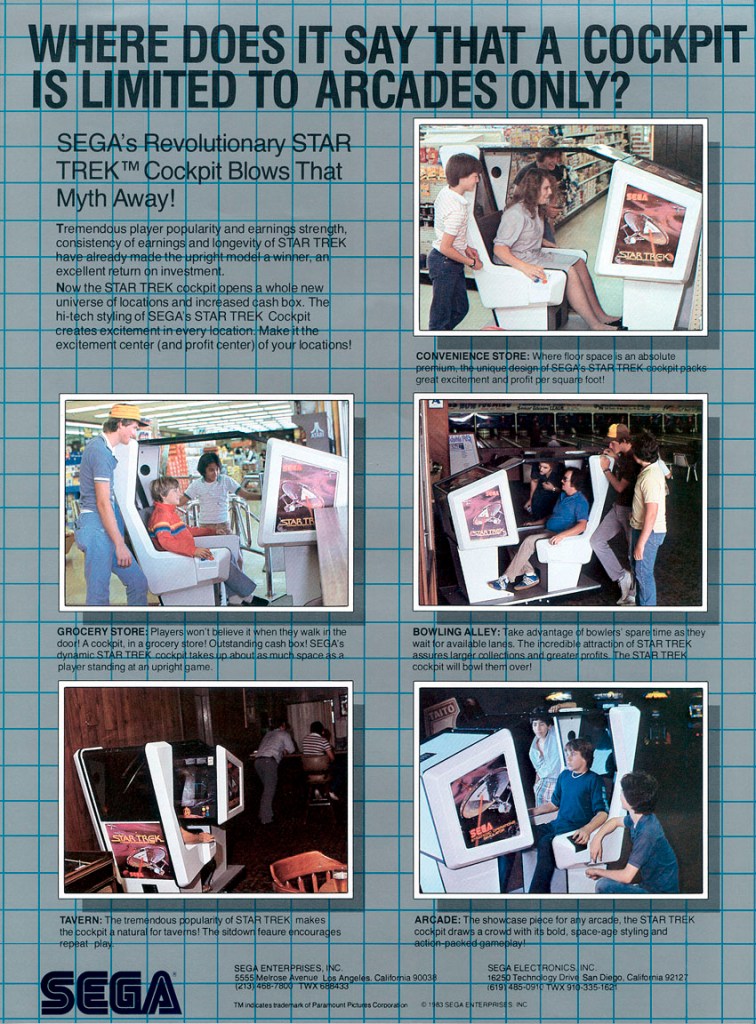
SEGA’s revolutionary “cockpit” arcade cabinet.

The arcade game was released in two versions. The standard “upright” game cabinet model was fashioned after similar games of the day, with standard screen and control layouts. In addition, a special “Captain’s Chair” sit-down model was fashioned to simulate that on the bridge of the refit USS Enterprise as seen in the first three Star Trek films. Its controls were built into the chair in which the player sat, with the game screen situated in a separate console in front of the player. In both cases, the game included a rudimentary voice simulator which used Scotty’s voice to give you command, and Spock’s to welcome you aboard and announce entry into each sector. (Neither was the actual actor’s voice, but a computerized impersonation.)

Arcade screen graphics.

The player steers the ship by a rotary knob (situated either on the upright console’s front or the sit-down chair’s left-hand arm), while control for impulse, warp drive, phasers, and photon torpedoes are a set of four game buttons (next to the dial on the upright or on the right-hand arm of the sit-down’s chair). The game screen is divided into three sections. The upper left shows the player’s score as well as the ship’s amount of shield energy (green line), photon torpedoes (red boxes) and warp energy (blue line). The upper right gives an overall view of the sector, including enemy ships and starbases (with which the ship can dock to re-energize shields, restock torpedoes, re-fuel the warp drive, and repair any damage suffered from attacks). The lower part of the screen shows a direct forward view (similar to the viewscreen on the Enterprise bridge).

Memory Alpha